
Before It's Gone Journey
  • home
    • About Us
    • Contact Us
  • Blogs
    • Himalayan Livin'
    • The B.I.G. Cycle Journey
  • Get Involved!
  • Advice and Reviews
    • Apps

Saving Annapurna for "Another Time"

12/25/2014

6 Comments

 
Picture
Days 57 to 68
Highest Elevation: 4,000 m (13,123 ft)
Lowest Elevation: 840m (2,775 ft)

It became a tedious day of sitting in the dining room of our trekking lodge, huddled around a tiny coal heater since the only proper fireplace was in the forbidden kitchen. As gusts of wind pelted the windows with alternating bouts of rain, sleet, and snow, all of the trekkers speculated on the impact of this storm on the cross-ability of the infamous Thorong La and debated whether to continue up the trail or give up now. But for that day, no one was venturing further than dashing across the street for snacks to accompany pot after pot of masala tea. The upside was that our forced sedentariness, paired with a leisurely wifi connection, gave me the perfect opportunity to take care of all Christmas shopping in one fell swoop! By the end of the evening, Matt and I had even picked up a deck of cards for several rounds of rummy 500. We could not remember the last time just the two of us had played a game together.

By the next morning the storm had passed and it looked like the continuing-on camp beat out the ditchers with just a few folks catching jeeps down the valley. We stocked up on our food staples in the bazaar town of Chame with the cheapest prices we had ever encountered while trekking, then hit our first patches of substantial snow shortly thereafter. Since Annapurna is nicknamed the "Apple Pie Trek," we felt it was appropriate to eat it for lunch at what was previously a community apple orchard for local consumption. Now an entrepreneurial Kathmandu family has bought it, expanding the orchard in order to "export" apples by truck on the relatively new road. The owner we struck up conversation with claims that plans are in the works to pave the road within a few years. He proudly showed us the architectural sketch of a massive fancy lodge they will build once the orchard expansion is complete. Politely as possible, I inquired whether he thinks many trekkers will want to stay at a lodge on the side of paved road with trucks on it. He said, "Of course, we have to find the balance between tourism and industry." How exactly they will find that balance, I am not sure. Perhaps Annapurna could successfully morph from a world-class trek to a lodge-to-lodge road cycling tour... just watch out for those apple trucks!

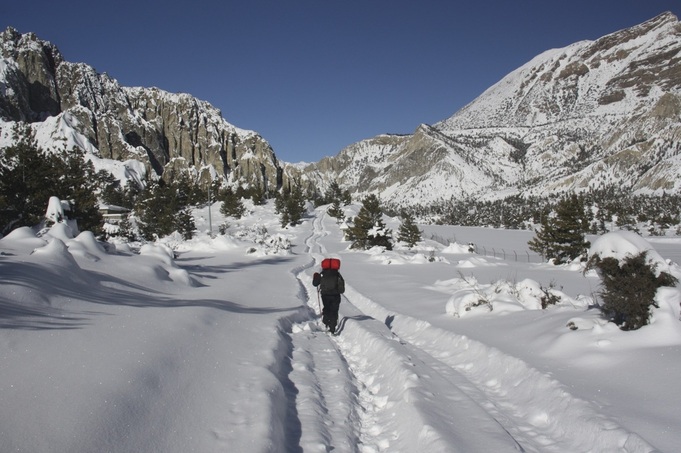
Above apple-pie heaven, we wandered in to beautiful winter wonderland that reminded us, with quite appropriate timing, of our traditional trip up to Montana for the holidays. It was both comforting and homesickness-inducing as this was the first Christmas we would not be spending there many years. To top it off, the conditions were perfect for cross-country skis, so we also missed them sorely. Instead we trudged along a narrow path broken through the knee-high snow with the benefit that it was a gentle road-grade without the feeling of walking on a wide dusty road. Upon reaching our goal of Pisang right at dusk, we were recruited in to an extremely pink hotel. We initially resisted based on an instinctual color aversion, but the owners were friendly, the fireplace warm enough to dry our boots, and the food was good. While there may be a lesson here to never judge a trekking lodge by its exterior colors, someone should really tell Nepalis how off-putting pink is!

After a few hours of hiking under brilliant blue skies the next day, the weather turned quickly and we were scrambling to put on all the sweaty layers we had peeled off. The wind picked up enough that drifts of snow were filling in the trail through the now thigh-deep snow. Luckily, we were close to the little settlement of Humde where we ducked in to a locals' restaurant for a pot of instant coffee by their kitchen fire. We were hoping that this was just a squall that would pass over the course of lunch, but despite our best procrastinating, it persisted until we were forced with the decision of whether to push on to Manang or call it a day after just three hours of walking. We continued to the edge of town and felt the force of the wind beyond the protection of buildings, which pretty easily convinced us to turn around and find a cozy lodge. Once settled in to the Maya lodge, we spent another mellow afternoon and evening staying warm by the fire, playing cards, eating, and drinking. Things could be worse.

Despite a new layer of snow from the previous day, the going was pretty easy to Manang thanks to a tractor that had laid wide tracks through the snow. We were not the only ones taking advantage of this. The night before, a shaggy grey dog peered into our room when we had the door cracked open. The next morning he was curled up outside of our room and, certainly without any prompting from us, decided to kept us company all day, then disappeared once we got in to town. We later saw him again playing with some other dogs in the snow, so thought maybe he actually lives in Manang.

When we registered at the ACAP checkpoint, we were surprised to hear the officers reporting that Thorong La was most likely passable. With the quantity of snow, we had already resigned ourselves to simply enjoying the stunning views from Manang before backtracking down the valley. Now with a glimmer of hope (before realizing the extent of how absolutely clueless and worthless ACAP is), we decided we might as well approach the pass, taking it day-by-day and seeking out more information whenever and wherever we could. In this sense, we were no different than anyone else still sticking around. There is nothing like perceived adversity to bond tourists together, or perhaps an element of uncertainty simply gives strangers something to talk about with each other. Even since the snow hit, there had been a casual and implied camaraderie among all trekkers that we had only witnessed one other time in the days leading up to crossing the Larkya Pass on the Manaslu Circuit.

The route up to Yak Kharka yielded increasingly better views, worthy of a trip even without the possibility of crossing the pass. The trail was more challenging since had finally left the road behind at its terminus in Manang. On some of the steeper snowy slopes, it was easy to slip off the "trail" of singular packed footprints and plunge thigh-high into unpacked snow. Even under these conditions, it was a short day and we soon joined our loose group of trekking associates in one of two lodges open in the village. Although we felt bad for the fellow who didn't have anyone staying with him, we were keen to keep a beat on the others' plans. Besides, our shaggy grey dog was waiting for us there after following some Danish dudes up the trail earlier that day!

The arrival of three more competent trekkers returning from higher up corroborated the decision of a French mountaineering couple we had chatted with on their return that morning. The problem was not at the pass, but an area prone to landslide even in dry conditions before the next acclimatization points of Thorung Phedi and High Camp. An icy section of trail had but the width of footstep carved out of the steep slopes plummeting to the river below and some looming avalanche risk from above. This latest news introduced yet another maze of decisions to navigate through. Do we take the word of at least five seemingly experienced and moderate-to-high risk travelers who turned back? Do we hike up and see it for ourselves before we decide? If so, do we take our backpacks or leaving them at the lodge? Do we wait for the large well-equipped organized British trekking group to arrive and tag along if and when they cross? If we wait a few days, will it melt out? And is it worth waiting if we still don't know whether or not the pass is passable?

It was all too overwhelming to make a logic-based decision, so we ended up going with our gut telling us it was time to turn around. Our gut was listening to our wet feet who were tired of hiking in the snow, our antsy pants who didn't like to prospect of killing more time at trekking lodges waiting for weather to cooperate, and our hearts' desire to have an excuse to come back some day and do the many side trips in the Manang area (like Tilicho Lake) that were not feasible with the recent snow. And most importantly, we had to look out for the safety of shaggy grey dog!!!

Now you would think that this dog, who hung around for three days without getting any food from us, would be bonded to us for life once we caved and brought him a hearty portion of dal bhat and some canned hot dogs. So we figured we had better give him a name and there was only one that fit the bill: Dawa. It was no surprise when he followed us down the trail from Yak Kharka, but after we crossed paths with the big British group heading up, he was nowhere in sight. Without even saying goodbye, he latched on to what was no doubt an upgrade for handouts and leftovers. It seems that Dawa is a true trekking dog, keeping tourists company up and down the trail at his whim.

We made up for all of the recent short days with a long push all the way down to Pisang. Not one of the fifteen or so trekkers who had congregated at Yak Kharka had decided to continue up, so we spotted many of them throughout the day as we dispersed on our own courses for our return trips down the valley. We ended up staying in the same very pink hotel again with just one of them, a young German guy named Tobias. We had first met him in Manang when he had just returned from being snowed-in for a week at Tilicho Lake. He was also one of the three at Yak Kharka who had turned around after assessing the sketchy spot. Little did we know just how many times we would coincidentally meet up with Tobi in our future.

While the next day felt like a relief to hike below the snowline, we became disheartened about our decision as we shared our experience repeatedly to each passing trekker curious about why we were heading down and eager to get information about the conditions that lay ahead. If the warm and sunny weather held, it was likely they would be able to cross the pass by the time they got there. We second-guessed ourselves that we had been too impatient to leave, yet at the same time we felt that 63 days of continuous trekking was catching up with us. Our legs and feet were taking a beating from hiking downhill on the hard-packed road, more brutal than any rocky trail. In our hotel for the night, appropriately with Tobi as the only other guest, we formulated a plan to still trek all the way to Pokhara on what has been dubbed "The Homestay Trek" through scenic villages populating the temperate middle hills. This seemed to reconcile our mixed-emotions of the day.

The next day we passed into new territory for us after descending along the road past Dharapani, where we had joined the AC from the Manaslu trek. We escaped the road temporarily by crossing a suspension bridge over the river to hike on a parallel trail on the other side until we reached Tal, recommended to us by Tobi. Tal almost had a beach town feel with some sandy beaches close to its riverside location. We found a great lodge called the Potala where several miraculous things happened: the awesome didi upgraded us to a brand-new "luxury" cabin with a private bathroom, it was warm enough to shower and do laundry, and Tal has a local specialty that was filling, absolutely delicious, and most importantly, not dal bhat! I don't remember the name unfortunately, but I could have eaten the potato-pumpkin-bean curry with corn bread forever.

A couple of hours after leaving Tal, we rounded a bend near the river to find a tiny baby goat standing on a boulder all alone and bleating its lungs out. Now, if you have been reading this blog semi-regularly, you may have picked up on the fact that I have become slightly obsessed with goats, especially baby ones. So I was not about to walk by this baby goat and just leave it there. It needed to be saved! I called to it and it immediately jumped off the boulder and fought its way through a million sticker plants only to arrive right at my feet covered in burrs. I picked it up and it calmed down and stopped bleating. I looked at my husband, who was already rolling his eyes and taking off his pack, knowing exactly what was in store.

The nearest village was fortunately not very far back, but unfortunately up a long switchbacking hill. But this baby goat needed to be saved! Midway up, I was relieved to find a herd of goats roaming around so I put baby down right in the middle of all of them. They sniffed it, and just kept going. Baby just climbed to the nearest rock and started bleating again. Clearly these were not the right goats, so up we went. I found a woman sitting in front of her hut who didn't seem too phased to see me carrying a baby goat, so I handed it to her. She set it down and it curled up next to her, a clear sign that the baby goat had been saved! Hooray!

I scurried back down the hill to my patiently waiting husband and arrived just in time to see a Nepali man coming from the opposite direction, scanning the area above and below the trail as though he was searching for something, say, perhaps, a baby goat? I tried to ask in basic words and gestures if he was looking for a goat, but he just looked confused, pointed down the trail and said the name of the next town. My husband just shook his head and accused me of being a kid-napper, adding that he can only imagine what the woman up the hill will be having for dinner tonight! My only recourse for revenge was every time we saw a baby goat after that, which was frequently, I would whine, "Awwww, all I want for Christmas is a baby goat!"

In these last few days of trekking, we were preoccupied with finding alternative trails to minimize our walk along the road. We even climbed and descended more than 3,000 feet to pass through some less-visited villages on the gentle hilltops above the steep-sided river gorge below. Coming down, the din of a 50MW hydropower plant under construction near Bhubhule increased with each step until we were at eye-level with the mess of it all. The hydropower project is 90% backed by the Chinese corporation Sino Hydro, surprisingly China's first foray into a country with huge amounts of untapped hydro potential. In a country where "load-shedding" creates power cuts for over half of each 24-hour day, the signed power purchase agreement means that Nepal won't be keeping much (if any) of the electricity generated. With Nepal's government being one of the most corrupt on the planet, the sale of power to China won't be benefiting the everyday people of Nepal either. The worker strikes that have been slowing the project since its inception aren't even that farsighted. The workers demands are simple: a pay increase to a whopping $6 per day, a health center and ambulance on site.

Signs along the road near Bhubhule appeal to all of the tourists who jeep up to Chame to begin their trek above the chaos. They claim, "If you choose vehicles you might miss homestay, community stay, hospitality, cultural varieties, and treking experiences." This may be true, but can you really blame anyone for passing by? After doing it on foot, we can't. I have heard that the vast majority of local people who live along the Annapurna Circuit were in support of road construction. The appeal of making everyone's lives easier overshadowed a few people's concerns about impacting tourism. Now efforts are being made to create alternative trails and incentives for people to stop prior to the need to acclimatize forces them out of the vehicle. Perhaps some thorough, dedicated souls will take them up on these offers, but the ease of jumping in a jeep and getting to the good stuff faster is just too alluring for most.

Shortly after setting out from Bhubhule the following morning, we reached the turn off for our "Homestay Trek" that would take us as close as possible to Pokhara on foot. It sounded really cool, it seemed off the beaten path, it was certainly totally our style, yet we could not muster the energy to begin the climb out of the valley. The road had sucked the life out of us. We sensed that we could make it happen, but it would be forced. We questioned whether we would enjoy it enough to make it worth it. Or was it time to be done? It was. Instead, we ambled down the road to the traditional jumping off point for the Annapurna Circuit trek, Besi Sahar.
A depressing way to end an incredible trek for sure.

Two bus rides later, the fastest we had moved in over two months, we were in the touristlandia of Lakeside, Pokhara. It was Christmas. We celebrated with pizza and beer.

A few important lessons we learned on our 68-day trek:

  1. Showering is overrated, but doing laundry is even more so.
  2. Breakfast is important, and second breakfast is even more crucial.
  3. Life in the mountains is relatively comfortable if you are a foreign trekker passing through, but "real life" in the shadow of snowy peaks is a challenging endeavor. Nonetheless, the conglomeration of cultures that make up the Nepali people are some of the warmest, friendliest, and most welcoming on the planet. The trek ended up being as much about the people we met as it was about the scenery.
6 Comments

Nar Nar Phu Phu, Bhai Bhai!

12/13/2014

0 Comments

 
Picture
Days 49 to 56
Highest elevation: 13,484 ft (4110 m)
Lowest elevation: 7,185 ft (2190 m)


We said goodbye to the Manaslu trek that we had come to love by tying one of our khatas to a bridge just before the river's confluence with the
Marsyangdi River, marking our transition onto the Annapurna Circuit. The checkpoint for our conservation area permits and TIMS (Trekker Information Management System) cards made it official. Walking through the junction town of Dharapani, I gave it the Most Hideous Hotels award before I knew this would be par for the course as we continued up the road past other villages, finally deciding to stop at Danaque. We chose the Motherland Hotel based on the friendly didi, definitely not the color-scheme of aquamarine walls with Pepto-pink and lavender accents. We decided there must have been a regional sale on every shade of obnoxious paint color imaginable, especially pink. The gaudiness of the colors was enhanced by the interesting choices of combinations applied to the cheaply constructed concrete buildings. Inside the room was much less nauseating, with the typical plain wood paneling rather than the anticipated sloppy paint job of, say, neon green with bright yellow trim.     

The next day was a short one, with few options to walk off of the road unless we were short-cutting switchbacks. Fortunately, only a few jeeps passed by filled with Nepalis, presumably heading down to warmer climes for the winter. We had to stop in Koto, where a trail heads up a side valley to the remote villages of Nar and Phu. It would be too far to make it to the first village of Meta that same day, so we did the usual rest day routine of laundry, followed by internet, followed by eating, followed by the bonus of sorting out our camping gear to leave behind for our third out-and-back (or more appropriately up-and-down) side trip of the trek. Yay!

Except for some dramatic sections of trail that had been carved out of riverside cliffs, the path climbed steadily through forest until reaching Meta. We were disturbed to see the extensive tree-harvesting, likely for yet more tourist lodges. When Matt asked Dawa what he thought about the wood cutting, he shared about how the forest is managed around his home village in the Kanchenjunga region with quotas and taxes set by the government but self-regulated by the community. While he didn't know the details of the system we were observing, one can only hope that the Annapurna Conservation Area has something similarly effective in place.    

In Meta, we shared a hotel with likely the only other tourists in the valley, a friendly couple from Alaska who hiked in t-shirts while we donned fleeces and wool hats. The next day we leap-frogged up the trail with them all the way to Phu. The landscape transformed into arid, rocky expanses dotted with stubby juniper trees. We passed a couple of villages just beginning to be inhabited as residents of Nar and Phu were descending to their slightly more livable elevations during the harshness of winter. The style of the stone-walled buildings blending in with their surroundings, especially combined with the juniper and red rock walls, had us thinking of the Ancestral Puebloan sites in the US Southwest.

The valley narrowed again and we worked our way through rocky riverbanks sandwiched between vertical walls and the remains of avalanches that came down during the infamous October storm. Our guide learned from locals that one of the debris-covered ice paths still contained three French trekkers, although the bodies of Japanese and Indian trekkers had been recovered. It was strange and disconcerting to think that we could be walking over dead bodies encased in the snow beneath us.

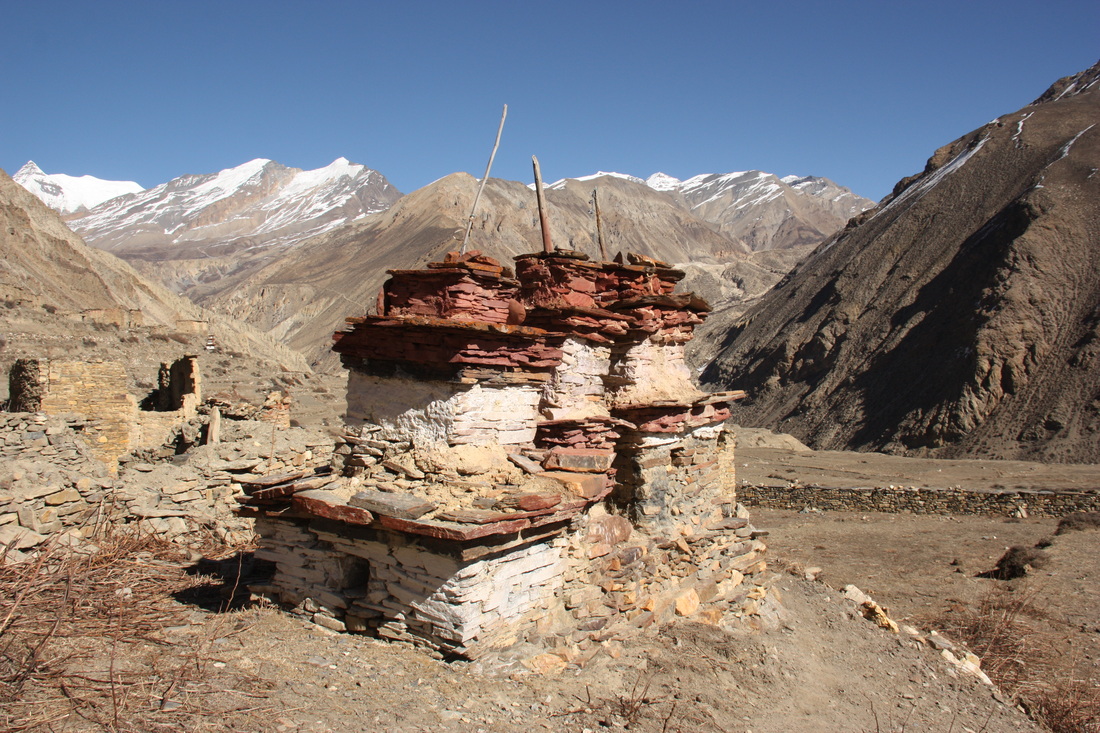
A loose steep climb brought us up from the river to look down upon the vertical gorge and the ruins of what looked like a medieval fortress the size of the small butte it was perched atop. Crumbling chortens with fading ochre walls and aged mani walls led the rest of the way to Phu. It felt like we were about to discover a lost civilization that was still living half a millennium back in time. It also felt like we might encounter it in a state of mild hypothermia as a frigid wind whipped through the open valley, signaling that winter had arrived before we had. Even the Alaskans had to put on more clothes during the last stretch to Phu!

Of course, we were not the first to discover anything and the town was indeed in touch with modern times, even if the cluster of buildings did not hint at modernity from a distant first impression. Only one of four hotels was still open, and even then they seemed reluctant to host us as they too were closing for their winter migration down the valley in a couple of days. The sun had long set behind the mountains, so we saved our wandering for the next morning and headed to the kitchen where the family huddled around a tiny fire and the guests were relegated to a table in the far corner next to the door. This would not have been so bad except that with their coming and going they never shut the door. Matt got up about seventeen times to shut the door after them, making it more and more obvious each time, but they didn't catch on, or more likely didn't care. I was not fully warm until the middle of the night when we finally accumulated sufficient collective body heat in our double sleeping bag. 

The next morning we took it easy, waiting for the sun to hit the village before venturing outside. A short walk up to a monastery on a neighboring hill provided a new perspective of Phu, but unfortunately the caretaker with the key had gone to collect firewood, so we did not get to peek inside. We were amused by a newly observed trend of covering the mani stones and other religious objects with garish colors of blue, yellow, and copper-colored paint. I quipped, "This is what happens when good Buddhists get a hold of bad paint!"

It did not take long to explore the rest of the mostly empty village, so Matt and Dawa climbed up another steep hill on the other side of Phu while I sat on the wind-sheltered roof of the kitchen, collecting the benefits of sun alongside our little Goal Zero solar panel. The mother brought her young children there as well, so I was soon surrounded by clothes changes, face washes, and baby oil rub downs in the only place warm enough to bare skin.

The remainder of the day became a little drawn out since it was not the most comfortable place in terms of amenities, food, and attitude of the hosts, but we had to keep with our established tradition of taking our rest days in the highest, coldest, and most expensive places possible on each section of the trek. We were more than ready to hustle out of there the following day along with every type of domestic animal in the valley: horses, goats, sheep, and yaks. Only chickens were not being herded down valley alongside us as we descended. 

In contrast to our experience in Phu, we were welcomed in to the immaculate Satek Gompa by the equivalent of the director or headmaster, since it primarily serves as a school for young monks-to-be during more favorable seasons. The pupils were already in Kathmandu for the winter, but many of their teachers remained at the monastery. The main entertainment of the evening was observing what would definitely be defined as cat torture in the household of my upbringing. With everyone sitting on the floor around the fireplace, the teachers, headmaster monk and even our guide, passed around a little black kitty for some whisker-twisting, puppeteering, and my personal favorite, whacking with the spinner of a handheld prayer wheel. The amazing part was that the cat put up no defenses or made any attempts to escape, and except for some annoyed verbalizations with ears pointed back, it seemed to love the abuse (or the warmth of the fire and prospect of food scraps made toleration worthwhile).

On our way up switchbacks that covered the entire side of a mountain the next morning, we welcomed the breaks to answer inquiries from locals headed down. Without fail, each started conversation exactly the same way, "Kang La?" Each time that we said no, they looked a little confused. Kang La is a 5,315-meter high pass with a trail that connects Nar to the Annapurna Circuit further north than where we had left it in Koto. Dawa had insisted that we could not cross the pass due to icing over from the big October storm, so we were surprised to hear locals telling us that we should go. When we questioned him about the discrepancy, he clarified that he personally would not attempt it without ropes, crampons, and an ice axe, and added, "If you showed someone from Nar an ice axe, they would not even know what it is, but they would still cross the pass!"

Our approach to Nar did not feel as exotic or dramatic as Phu, but overall was a much more welcoming place, both climatically and socially. The sun hung in the sky much longer before dropping behind the mountain which allowed for a lovely lunch on our hotel's porch and an afternoon of ambling around town. We found it odd that this was the only place we had seen on our entire trek that had streetlights, powered by a micro-hydro plant. Once the essential sunlight was gone, we were invited to sit on floor cushions by the kitchen fire which became a traditional Nepali cooking show. It was amazing to see what deliciousness could be created atop two holes in a wood stove top, with a calm sequence of stirring and adding ingredients, then switching out pots from the heat source. We had to stifle immature giggles while our friendly hostess was making a batch of Tibetan tea. The plunging of the long cylinder to churn the butter, tea, and salt together sounded just like the unclogging of a toilet!

Our rest day in Phu was the first time I felt like it might be time to stop trekking, but this perspective would come and go during the following days. While we were heading in to the new territory of Nar and Phu, the uniqueness of the landscape was different enough from what we had seen that it kept us excited and motivated. I had developed the habit of referring to Nar-Phu as "Nar Nar Phu Phu Bhai Bhai," bhai meaning "little brother" in Nepali. This was a facetious adaptation of the already facetious and dated ski-bum speak "Gnar Gnar Pow Pow Bro Bro," but apparently was an effective chant to bring the snow.
On our return from Nar, fluffy clumps of snowflakes floated down from above, reminding me of our standard response to route inquiries that had essentially developed in to our trekking mantra, "We'll keep going until we get to Pokhara, or until the weather stops us, which ever happens first." As if the snow was not enough of an indication that winter had arrived, our room in Nar was so cold that Matt found his contacts frozen in solid solution at 5:00am that morning.

Crossing a slippery icy bridge was our farewell moment to Nar-Phu and our welcome back to Koto on the Annapurna Circuit. Once in the lodge, we hastily dried off and headed to the minimal warmth of the dining room. Dawa, the guide who had not showered or changed his clothes for nearly a month, disappeared carrying a bucket of hot water and reappeared wearing a pair of pristine jeans and fresh shirt. This partially solved the mystery of what was in his large pack that he never seemed open! Perhaps he wanted to leave a good last impression with us, but more likely he was trying to be considerate of everyone else on the jeep and bus transport he would be taking back towards Kathmandu the next morning. We had a modest celebration of our awesome month of trekking together that evening where Matt discovered that chang really wasn't so bad after all. Since beer was not worth the price and he couldn't handle the harshness of raksi, we had sampled the fermented rice-drink called chang early on in the trek. With opaque chunks and weird flavor, we had been avoiding it ever since. Perhaps there was simply something wrong with that first one, because the clear and chunkless beverage was pleasantly similar to a mildly sour craft beer.

The next morning, a forceful wind was still blowing in alternating gusts of rain, sleet, and snow. Koto seemed to be right on the snowline since we could occasionally get glimpsed of the snow-covered hillsides surrounding us. We had descended from Nar not even a day too soon. We said goodbye to Dawa as he climbed into the back of a jeep going down the valley and wondered if we should have been leaving with him too...
0 Comments

 Dear Majestic Manaslu, We love you!

12/5/2014

1 Comment

 
Picture
Days 42 to 48
Highest elevation: 5,160 meters (16,929 feet)
Lowest elevation: 2,700 meters (8,858 feet)


When we returned to Lokpa on the Tsum Valley trek, our guide learned that Manaslu Conservation Area officials had been there to spread the word about a key hotel on the route closing on December 3rd. There is only one hotel at Dharmasala, the last stopover for acclimatization before the 5,000 meter Larkye Pass. The three of us made a plan that we would put in some big days to see if we could make on the night of the 2nd. If we failed, then we'd still continue over the pass, but with the bonus of all three of us having a very cold and yet cozy night in our two-person tent together.

Luckily, after forty days of trekking, it didn't seem so painful to get up before the sun and be packed and ready to go before breakfast. Our bedtime had gradually crept earlier and earlier to the point that we would be in bed by 8:30pm and still get our nine or ten hours of sleep. We undertook two arduous days of hiking up the river valley with sporadic pine forest that reminded us of Colorado. By the end of the second day, my legs were not responding to my brain urging them to go faster, so I begged our guide, "Dawa, carry me!" He didn't, but his Everest-climbing Sherpa stamina probably would have allowed him to without too much difficulty. It didn't help that our hunger levels were high, thus making our energy levels low, due to an unusually horrible lunch stop.

Having had delicious pumpkin soup earlier in the trek, I had become fixated on a repeat experience, but every place either didn't have pumpkin or claimed to not know how to make it, despite it always being on the menu. Finally, a cook agreed to make it, but what came out was a watery broth with microscopic shreds of pumpkin, truly a major letdown, but if only that was the only issue... I spied something black and oval with a little pointy tip floating in the spoon headed towards my mouth. I exclaimed, "That looks like mouse poop!" and Matt responded, "Maybe it is a seed." I was hopeful, but I could not think of any type of seeds that looked like that while I fished it out of the soup. Sadly, it squished on the table, confirming my fear. The old saying "if you don't laugh, you'll cry" definitely applied to this moment and I simply blurted out, "Wait a minute, we ordered pumpkin soup, not poop soup!" We then told Dawa, who yelled to the cook. He came out and meekly said sorry, but that was all that was offered as he cleared my half-eaten bowl and Matt's empty one. When it came time to settle the bill, we had to inform him that we would not be paying for the soup. He said, "Ok, one bowl free discount." So then we had to explain that since both bowls came from the same pot, they had both been contaminated, so actually it would be "two bowls free discount." Incredible!

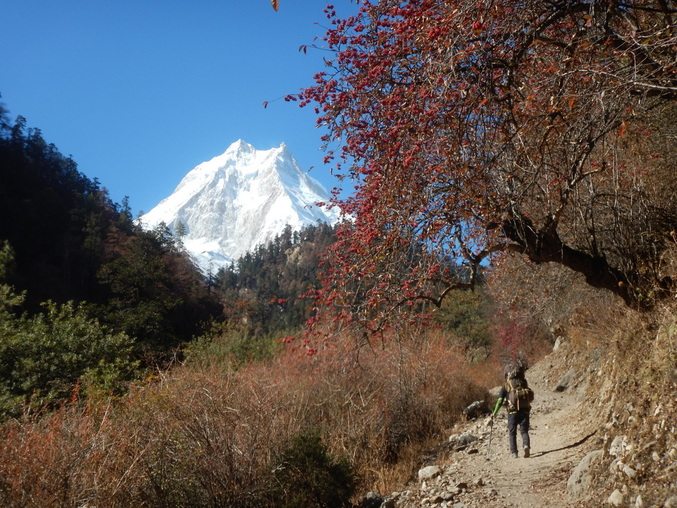
We reached the town of Lho just in time to see the truly majestic Mount Manaslu bathed in golden sunset light. Then we promptly settled in to a brand new place, aptly named Majestic Manaslu, with adorable little cottages and more importantly, Wifi. It had been a few weeks since we had made contact with our families. We had also caught up with the fabled "Group of Six" as we dubbed them, significant because there was a rumor running up and down the trail that the key hotel might stay open an extra day for a larger group. Feeling pretty beat, we decided to take our chances and slow the pace of our remaining days before the pass to match the Group of Six's plan.

Since we no longer had to run up the trail, we had the opportunity to sleep in and take a leisurely morning. Inevitably, this resulted in us being awake to watch the sunrise, but one that was so stunning that it confirmed Manaslu as my favorite mountain on the trek thus far. After breakfast, we walked up to a monastery on a hill overlooking the town, then ambled for just three hours to Samagaon, shocked at its substantial size compared to the other villages on the trek thus far. The logical, though not intuitive, explanation is that the valley widens in its upper reaches, so there is more physical space to build houses and plant crops that sustain a larger population. Once inside our well-constructed lodging for the night, we enjoyed comparatively advanced development such as luxuriously thick mattresses. We were informed that the nicer amenities can be attributed to proximity to the Tibetan border. It is easier for these higher elevation communities to import goods from China than it is for the lower communities to access products from Kathmandu. Another contributing factor is that Samagaon is the base village for expeditions heading up Manaslu, with the base camp location visible from our hotel's rooftop lounging area.

We extended another short day by taking a detour to a gorgeous glacial lake en route to the next village of Samdo. First we climbed to yet another seasonally-deserted gompa (monastery), then Dawa led us on a thorny bushwhack to intersect the trail to Birendra Tal, where a collection of cairns crowded the rocky shore. We could hear the glacier above us rumbling, but saw no evidence of its movement. Once in Samdo, we joined the other trekking parties who had also adjusted their itineraries to pace with the Group of Six. There was indeed power in numbers, since apparently the manager of the hotel had left the key hotel that very morning, was intercepted in Samdo and informed that fifteen tourists plus all of their guides and porters would patronize his business if he stayed open just one more night. He immediately turned around and walked the several hours back up the incline he had just come down.

Samdo is a purely Tibetan village, founded by refugees who crossed the border in the early years of China's invasion. The first residents established the village and claimed land rights based on a set of 600-year-old copper plates, so reports our guidebook. Apparently, the Nepali king supported their claim, but other local people contested the validity of it all so relations are not so warm between Samdo and nearby villages. In addition to the typical Tibetan layout of narrow stone passages lined with densely-constructed two-story homes, we noticed banks of icy snow in the shadows of buildings. A month and a half later, the remnants of the unseasonal heavy snowfall from the freak storm that hit Nepal's western regions in mid-October still persist.

It was a treat to have three easy days in a row leading up to our push over the pass. The now expanded Group of Fifteen made their way up to Dharmasala, each climbing at their sub-group's preferred pace. Upon arrival at the very basic lodge with an "open toilet," meaning go wherever you like except not in the locked up bathroom, it became instantly apparent why the manager was willing to stay open one more day. We understand the principle that prices go up with increasing elevation, but here was a monopoly that could get away with charging rates that did not correspond with our measly 1,600-foot gain from Samdo. To top it off, we then learned that we would be kicked out at 4:30am the next morning, since the three remaining staff would be departing shortly thereafter to catch a helicopter ride from a village far down the valley. Had we wanted to start hiking in the middle of the cold dark night, we could of left from the comfort of Samdo instead! Our move up to here was intended to allow for a daylight departure, in addition to a little more acclimatization.

On a brighter note, we had our first sighting of blue sheep, somewhat like a more slender bighorn, although on a darker note, they were sniffing around the garbage that was dumped downhill from the lodge. Like so many lodges, they either burn their plastic waste or have an "open disposal" strategy, where the nearest stream, river, or steep hillside suffices for the concept of "away" in throwing it away. While it is easy to be upset by these practices, it is much harder to think of a viable alternative for the waste. Paying for porters or pack animals to take it out is simply not cost effective; they would have to voluntarily carry it out and without a vested interest in doing so, that doesn't seem to happen. The other solution is prevention by not hauling in plastic-packaged foods in the first place, but the tragedy of the commons prevails again. If one business refused to sell Coke, Snickers, and cookies, then they would simply lose out on sales while tourists and locals alike shopped elsewhere. As for us, we still ate our fair share of cookies, but we carried our wrappers back to Kathmandu and delivered them to Beni Handicraft to hopefully incorporate in to handbags, coasters, Christmas ornaments and bracelets.

After a mostly sleepless half of a night for me at least (thanks a lot, elevation!), three Norwegians, two Kiwis, a German couple, a Finnish couple, a French guy, a Spanish guy, a British guy, a fellow Californian, all of their guides and porters, and ourselves all set out between 3:00 and 4:30am. We were the last to leave just as a bright moon set behind the mountains, but we benefited from the eminent closing of the lodge as extra pancakes, hard boiled eggs, and even packs of cookies were offered up free of charge. It was a great boon to have some extra calories on this day in particular, for which we had been unwilling to make the financial investment.

We were wearing all of the clothes we had brought on the trek, but just barely maintained warmth as we steadily plodded uphill. The one time that we really needed both of our headlamps, one of them was dead, so we three walked closely together with Matt dimly sandwiched between the beams of Dawa and myself. Before too long, the first hints of daylight crept over the black silhouettes of mountains behind us. As numbing as it was, I could not resist pulling off my gloves to take some photos. We were exhilarated to be among the mountains and glaciers as they gradually woke up with light, now feeling quite pleased to have left so early without a trace of our initial grumpy grogginess.

We reached the summit of the pass shortly after the other groups, some of whom were suffering a bit from the altitude at just under 17,000 feet (5,160 meters). We rested and ate as long as the chilly wind would allow, snapped some celebratory photos, and watched Dawa add his khata from the lama at Mu Gompa to a collection of them on a rock cairn marking the high point.

For us, going down proved to be much harder than going up. When we were not picking our way through scree fields and loose ball-bearing shaped pebbles, we were tediously inching along an icy slope with just enough previous footsteps to allow our own to hold. Dawa's mountaineering expertise kicked into action as he thoroughly tested each step with his trekking pole and instructed us exactly where to place our feet. We made it past the seemingly endless section where a slip and fall would have really serious consequences, took a breather, ate a third breakfast (or was it a second lunch?), did a costume change for the much warmer weather, and actually paid attention for the first time to the new mountains surrounding us.

Meanwhile, the Three Norwegians and the Group of Six had cruised down the 5,000-foot descent to the flatter ground of Bimthang, their crampons leaving telltale marks of their confident sure-footedness behind. On the other extreme, we worried about the single British guy with an inattentive guide until they showed up at our lodge around 6pm. At one point, Dawa even ran back up the trail until he could see them as tiny dots coming down the ridge line, worried that distance was only increasing between them and assistance if it was needed. It was moments like these that made us so grateful for having a caring and competent guide, not only for our safety but to enjoy the company of a truly "good soul." It had been an overly strenuous walk of 15 hours for him, but he was in better humor than I would have been. Upon arrival, he poked his head into the dining room and simply stated, "Well, I figured that if I started in the dark, I might as well finish in the dark!"

Our super-group of fifteen had mostly dispersed to different lodges based on each guide's preference, but our bond was strong enough that we all visited each other to say goodbye the next morning as some took a rest day and others continued on. We were in the moving-along camp, but did not make it as far as the others down the beautifully forested trail. It turned out that our legs were more tired than we realized when we decided to keep going.

We were the only guests at the isolated lodge in a forest clearing where a momentous occasion occurred: Matt took a shower, his first one in 18 days! For over two weeks, there was either no electric/gas/solar hot shower, or the air temperature was deemed too cold for a bucket shower, a bucket of hot water was too expensive, or the hot water would have been heated with firewood, which is supposedly a big no-no for low-impact trekking, even though the majority of our meals have been prepared over wood fire. I had survived two frigid showers since Matt's last one, with the only comparable experience being the polar bear plunge into Flathead Lake on New Year's Day back in my wild and crazy youth. After one of the cold showers, my toes were numb for at least an hour afterward, despite padding around with two pairs of socks and my mittens on my feet.

At first we couldn't see what the all the buzz about Manaslu was about. We were a bit put off by the higher prices than other regions with proprietors that were generally unwilling to bargain. The local folks seemed pretty ambivalent about our existence. With a mandatory guide that adopts the go-between role between trekkers and lodge staff, there was little opportunity to get to know them, so our stays felt much more impersonal. We now had to make intentional efforts to chat with the people running the hotels, which had happened so naturally before. With the increased reliance on mule trains for transporting goods, the trail was also much dustier and poopier than any other we had hiked in Nepal. The river gorge and forests were beautiful, but not particularly unique to Manaslu.

However, our experience only improved as we continued around the circuit and our perspective gradually changed for the better. The lodges got more intimate and friendly and less crowded with other tourists. The landscape became more dramatic the further up the route we hiked. The trail was forever dusty and poopy, but we got used to it. The prices remained high and higher, but we mostly adjusted our expectations. In the end, we became two more members of the Manaslu fan club, even if we weren't initially won over quite so easily.

Manaslu has exploded in popularity in the last ten years, with the number of trekkers increasing substantially each year. According to a graph in a MCAP checkpoint office, there were 344 permits issued in 1995 and 4,978 permits in 2013! This may be due to trekkers seeking an alternative to the famous Annapurna Circuit as roads almost entirely encircle it now, and in fact Manaslu has been promoted as the AC of twenty years ago. Locals are banking on that numbers graph to continue its exponential curve upward too. Each town seemed to have more new hotels under construction than finished ones, and many were of a scale we had not yet seen while trekking. While Manaslu's character will continue to change as it gets busier and busier, I believe it has potential to be regarded as a world-class trek, like Annapurna Circuit once was, if and only if it remains roadless. However, here in Nepal, that is a big if...

1 Comment

There's Tsum-thing Special about this Valley

11/28/2014

3 Comments

 
Picture
Days 30 to 41
Highest elevation: 12,138 ft (3,700 m)
Lowest elevation: 2,851 ft (869 m)

Leaving Yarsa in a hurry to be rid of our now seemingly ungracious hosts, we made it to the next village in record time after a tea and cookie break to debrief and reduce our blood pressure a bit. At the edge of town, we started down what looked like a main trail but locals denied that it went to Machakhola, instead pointing to a thin trail through a millet field. This seemed unlikely, but we were under the watchful eyes of the strangers we asked, so we proceeded. The trail cascaded down what felt like eighty terraces, each vertical wall with only slippery nubbins of rock to step down, or rather fall down as we each did multiple times. This shortcut did not help improve our mood, especially once we spied a normal trail just a little ways beyond ours that led to the same bridge we needed to cross. 

Once across the bridge, we were faced with more confusing trail options than the section we had hired our guides for the previous day. Ultimately, it did not matter which trail we chose as all trails eventually led down to the Budi Khandaki river, but we did manage to reach the river quite a bit downstream from the town we were aiming for. Both the overgrown and rocky condition of the trail and the extra distance we then had to cover further contributed to the deterioration of our mood, especially when the suspension bridge spanning the river led to a sketchy narrow path down the side of a cliff. We carefully negotiated our way down while our hearts thumped with adrenalized blood. 

We walked along the river to Machakhola where we randomly chose one of the many concrete behemoths that they call hotels. Apparently we had crossed some sort of invisible expensive line as well. The hotel owner quoted us the most expensive price yet for a room and was unwilling to bargain, an everyday practice in Nepal including on all previous trekking routes. This also did not help improve our mood. After an overdue hot shower as the best part of our day, we ate the least exciting dal bhat possible, again not helping our mood.  

The lowest point in elevation on our trek at a mere 2,800 feet corresponded with our lowest emotional state as well, but the next day we were set on having a fresh start. We had a leisurely morning, cooking up the last of the oatmeal that we had schlepped around with us from Kathmandu. We walked just a couple of hours up the river to yet another village called Tatopani, expecting a nice spot for a soak in hot water. Instead, we found two spouts of lukewarm water with no pool below them. Not exactly a destination worthy of a rest day, but the one lodge in town was dramatically perched over the river and had a young friendly manager who cooked up delicious food such as fried banana pie. We hand washed our laundry with warm water from the spring for a nice treat, then spent the afternoon chilling in the balmy weather at outdoor tables set right along the trail through town. This made for a great spot to watch all the trekkers have the same reaction of disappointment upon first spying the "hot spring," muscular porters stripping down for a free hot shower under the spouts, and countless mule trains passing through with bags of lentils and rice, among other things no doubt, on their backs. We dubbed them four-legged walking dal bhat. Nuns on their way down to Kathmandu for the winter even stopped to shave their heads with the warm water, unfortunately then throwing the plastic bags holding their shaven hair directly into the river!

The next day was more of the same sort of people watching, taking bets on whether our guide would actually show up or not, and if so at what time. We had reluctantly pre-arranged a guide to meet us through Asian Heritage, an agency in Kathmandu, for the sections of trail where the government regulations require that we have one. Especially after a month of trekking on our own, we felt confidently self-sufficient and enjoyed having a leisurely schedule without anyone else to complicate it, so we were not particularly looking forward to his arrival. Yet sure enough, Dawa Sherpa came cruising up the trail at mid-afternoon, promptly handing over our passports, but hanging on to a month's worth of permits for the Manaslu, Tsum Valley, and Nar Phu treks into "restricted" areas close to the Tibetan border. For example, the first area he would guide us in to, Tsum Valley, was only opened to tourism in 2008. However, since he had been hiking since 3am that morning, we stayed put for the remainder of the day and chatted about routes and the usual get-to-know-you stuff. 

We got an early start, for us, the following day and after our first break I went to pull my sunglasses off their usual resting place on my ball cap and to my shock they were not there! We looked around without luck, so I decided to run back nearly an hour to Tatopani, chagrined that I had mocked Dawa when he asked if we checked our room for left items. Of course, they were not at the lodge either; it seems they had simply disappeared off the top of my head despite the fact that I always wore that very pair there for years. When we later caught up to Suzanne, another American trekker who we got to know at Tatopani, her photo of us proved that the sunglasses were indeed in place after departure, absolving me of forgetfulness at least. Dawa spent the rest of the day scoping porters heading down to see if they had "goggles" they might be willing to sell, explaining that they would become essential for crossing snowy passes later on. We did find some "awesome" ones the next day in a little shop for a bargain of three dollars. Now when I put them on, I say their "brand" name out loud with the coolest attitude I can muster: Air Force. I haven't gone snow blind yet, so they must be doing something...

At the first tourist establishment on the Tsum Valley spur, we again had the joyous opportunity to leave our camping gear behind, so our packs more closely resembled that of our guide, although his was still lighter. This was his first opportunity to trek Tsum a Valley as well, a fact which he was very open about and we certainly appreciated his frankness. His lack of firsthand knowledge actually helped us adjust to having a guide. Since he did not have an agenda nor favorite lodges to insist we stay at, our decision making was much more collaborative than we had been observing with other guides and their clients. His laid back and super flexible approach, paired with just the right level of attentiveness and an excellent sense of humor put our qualms about having a guide to rest within a few days.  

Despite having a wad of tobacco tucked in his lower lip more often than not, our guide may have one of the best grins on the planet. In Nepal, people rarely call others by their name, instead using the terms older/younger brother/sister. While we tended to stick to our own cultural custom of calling him Dawa rather than bhai, our Sherpa guide did indeed feel like our little brother. Sherpa is both his last name and his caste, a term that roughly equates to his culture. However, sherpa is also his profession when he is working on big mountain expeditions. A mountain sherpa may haul gear between camps, but primarily is climbing alongside the clients to assist them in safely reaching the summit. Sherpas are not the same as trekking porters, although the terms are often confused. As a mountain sherpa, Dawa Sherpa has climbed several of the famous 8,000 meter peaks, including Everest from the Tibetan side, Cho Oyo, and Manaslu, among other summits and attempts. 

While our outlook on having a guide certainly did a 180, we never got over the aggravating irony that as soon as one was compulsory, trail signs with arrows and estimated hiking times to the next village suddenly appeared everywhere, along with excessive hot pink spray paint arrows and dots in between all the signs. The only thing less pleasing than that route graffiti to foreign tourists' eyes is all the litter lining the trails. Between the signage and the garbage, it would be impossible for even the most clueless tourist to get lost. Perhaps it is to help all the guides who have never walked the route before look like they know what they are doing! In contrast, we had just completed five different sections of our trek independently with nary a trail sign at questionable junctions, nor a single drop of spray paint to reassure us that we were going the right way.

It was a straight shot up the valley anyway, taking us three days to reach the high point of Mu Gompa at 3,700 meters. Along the way, a highlight was having a woman shove a tiny lamb in my arms as we passed each other on the trail, while another one peered out of a doko (woven bamboo basket). I gave it back, but just barely. A culinary high was ordering a pumpkin pie for breakfast when Matt mistakenly thought it was Thanksgiving. Luckily, we were at a lodge where the young cook was more like a chef, having had professional training in Kathmandu. The pumpkin pie came out as a fried pocket filled with fresh local pumpkin chunks, caramelized sugar, and the occasional raisin. It was so amazing that a few days later, but still not yet Thanksgiving, we hiked in a very hungry state on our way back down the valley in order to eat there again for lunch. It was not a fluke, pumpkin pie number two was just as good, and we also tasted his apple pie for good measure.

Another lovely memory was being invited inside a traditional Tsum Valley home for some not very traditional Nescafé 3+1, that's three parts milk and sugar and one part coffee--I checked the ingredient list! On our way out, the hostess jokingly called Matt a monkey because he was so hairy. Later the same day, we had lunch in another traditional kitchen where the woman spontaneously grasped around Matt's calf with both hands and ran them up and down, presumably to see what leg hair feels like! 

Tsum Valley residents are Tibetan in origin, so Dawa felt right at home since his Sherpa community in Nepal's far east region of Kanchenjunga maintains many similar elements of its Tibetan heritage. The kitchens have extensive open cabinets where ornate silver vessels are on display framed by patterned woodwork. An eye-catching centerpiece was a shelf dedicated to several tremendous beaten copper tubs. Each one looked like it cost a fortune and we could not fathom why a home would require four or five. Luckily, we had a guide to explain that in winter all the water outside freezes, so they need to store a good supply of water inside the warm home. An small altar with butter lamps, offering bowls filled with water, and incense always occupied a high corner of the room as well. There were also photos of the Dali Lama, which are prohibited by the Chinese government just a few miles across the northern border in the Tibet Autonomous Region. 

A pleasant surprise was hiking on the flattest trail of our entire trek as we reached the upper valley, which widened into agricultural fields that must have once been a glacial lakebed formed by a terminal moraine dam. This allowed room for many chortens and long mani walls to compliment the mountainous scenery. In contrast, the lower valley was quite narrow with a formidable river grinding away at the task of making it even deeper below us as we huffed up thin trails that clung to the steep sides. 

An unpleasant surprise was encountering a road as the gentler terrain made its construction feasible. Since a road seems impossible in the lower valley, we wondered what the point of it could be. We learned from a Tsum Valley resident that the bulldozer, which we witnessed tearing up the ground inches away from a sacred mani wall, had to be helicoptered in to the site in several pieces. From what we could gather, this road has but one purpose; it is headed north to facilitate better, easier, faster trade with China. Locals already make the trip across the border, bringing back packaged foods, dish ware, and most importantly, cans of Lhasa brand beer on the backs of mules. It is the modern day equivalent of the traditional pre-occupation trading that Nepal did with Tibet, but now cheap and cheaply-made shoes have replaced gold dust, wool, and yak tails.

With one final steep climb, we arrived at the expansive monastery called Mu Gompa, largely deserted as all but a few monks and staff had already headed down to Kathmandu to escape the harshness of winter. We peeked inside the main gompa as a monk was performing daily chores, then arranged an opportunity to meet the eldest lama in his personal quarters. At 76 years old, he no longer descends to the main gompa to receive visitors. We were greeted with warmth and genuine excitement and settled on to cushions on the floor next to a small fireplace. We were then served some "tea" made from the ubiquitous Nescafé 3+1 (it must come from China!) and a plate of boiled potatoes that Dawa insisted on peeling by hand for us after we ate one with the skin still on. While Dawa's first language of Tibetan had proven handy for the entire trek, here it really illuminated our visit with the lama and put everyone at ease. The lama explained that his knees are too weak to make the trek down the valley, so he spends the winter here mostly alone. The thought of the loneliness to come brought tears to his eyes a couple of times. The only thing that kept tears from coming to my eyes too was the presence of a young attentive caretaker that the lama praised for his good work. At the end of the visit, we presented him with a small donation and khatas (silky white scarves). He in turn placed different khatas around our necks with a blessing.

On our way down the valley, we decided to take a side trip from our side trip by going up another valley branching off from Tsum. This time we stayed at a nunnery with just a couple of nuns overwintering, one particularly welcoming and gregarious. We cuddled in a blanket near the cooking fire in the dark kitchen, sipping tea and eating a new variation of the boiled potato: she put tiny boiled potatoes in the coals of the fire, rotated and pulled them out with tongs, setting them on the table before us. Dawa rolled them between his hands to remove the ash, then popped them in his mouth. We did the same, wondering why this time it was okay to leave the skin on. Dawa and she then used some great culinary teamwork to get the dal bhat underway. Bellies full, we retired to our "deluxe suite," only in the sense that the other option was sleeping on a semi-enclosed porch of the gompa. In our room attached to the side of the gompa, we spread out our sleeping pads and bag, then closed the "door" by hanging a burlap bag across the doorway. 

The next morning we took a side trip from our side trip that was already a side trip by hiking up another valley to see a glacier that was just out of sight from the gompa. Once up the valley a ways, we climbed up an old lateral moraine to be treated to views of several of the Ganesh Himal peaks just before all vistas were enveloped in clouds for the rest of the day. This was the real Thanksgiving (even though we had been celebrating with pumpkin pie a bit early!) and while dinner was just another dal bhat, we were grateful for where we had been, where we were, and the opportunity to keep going on this journey. We wished we could make contact with our families, but too many side trips had resulted in communication remoteness. 

Our last day descending Tsum Valley was a long one, made longer by a lunch stop in a one-lodge town off the main tourist track. In order to get a bowl of soup, Dawa first had to track down the owner, whom we found with her hands in deep in cow manure, mixing it with straw to spread as fertilizer on their fields. Oh, yay. While we can't confirm that any soap was used, she did scrub vigorously, including under the fingernails, before entering the kitchen. In the end, it didn't really matter since our guide is also a trained cook and was the one who made our Sherpa stew in her kitchen. It seems that he lends more than just a helping hand for many of our meals, but it works out all the better for us!

Our knees were aching from coming down several thousand feet to Lokpa, near the entrance to Tsum Valley. We would leave our side trip behind the next day, rejoining the Manaslu Circuit and its duplicate identity as the route for the Great Himalaya Trail. 
3 Comments

Cultural Encounters in Ganesh Himal Ruby Valley

11/16/2014

0 Comments

 
Days 22 to 29
Highest elevation: 12,631 ft (3,850 m) 
Lowest elevation:  5,826 ft (1,776 m)

Since we had arrived to Gatlang at dusk, when the cows were literally coming home, we took the next morning to explore its narrow paths lined with wood and stone homes. The gregarious hostess of the Paldor Peak Lodge packed us an awesome lunch to go: chapattis (thick flour tortillas), hard boiled eggs from her chickens, tomatoes, and a hearty spinach-like green locally known as saag picked from her garden moments before. 

After a strenuous uphill straight out of town, we were happy to find our way to a rumored cheese factory in order to add to the localvore picnic. With no sign, we identified it by laundry lines of cheese cloths flapping in the breeze like oversized prayer flags. The place billowed smoke from a fire blazing under a huge cauldron of future cheese being constantly stirred by an employee, driving home the point that our proudly-purchased local product consumes a heck of a lot of firewood in a country that is rapidly deforesting. 

We continued up, following a switchbacking road and taking shortcut trails between them as the terrain allowed. Two nice men slowed down to pace with us, through basic English we understood that they were on their way to a distant village for work. When we reached a kharka, a meadow used for summertime grazing with basic rock wall shelters, we decided to call it a day. Unfortunately, the water tap installed on the side of the road was completely dry. Quite fortunately, the local guys were there to point us down a path that eventually led to a trickle of water that we never would have found on our own, thus making our camping endeavor feasible. They continued, no doubt at a much faster pace without us, over a pass and down to a village we would reach the next day.

Despite the sun disappearing early and the cold settling in, it felt good to be camping on our own, partially justifying the weight and bulk of the tent. Dinner, on the other hand, was no scrumptious dal bhat. Our attempt to make passable spaghetti was foiled by dumping a dry tomato soup packet on the noodles, which promptly clumped up into goo balls. The stars were amazingly bright and the next morning the sun lit up Langtang Peak, which had been watching over our progress for a couple of weeks now. 

Crossing the kharka, a skinny dog with a slight limp appeared out of nowhere and adopted us, following Matt's heels diligently as we huffed our way up to the pass. Just before we crested it, our new friend ditched us and went ahead. While Matt chatted with some porters taking a break, learning that the men were carrying 45 kilos (99 pounds) and the women had 25-30 kilos (55-66 pounds), I found the poor old guy also resting in the sun and filled a ziplock bag with water which he promptly lapped up. After also feeding him a pack of coconut cookies, I expected him to follow us down the other side, but he didn't budge, even when I called him. While it may have been fun to continue our trek with a dog companion, I suppose it would have complicated things a bit in terms of lodging and food.

We descended steeply across road switchbacks much like how we ascended the other side, then followed a dirt road being improved for mining operations to a strip of homes called Somdang. The friendliness of the young man running the Somdang Valley Hotel convinced us to stay there, and his cooking was delicious as well. With a short, mostly downhill day, it was lovely to have a relaxing afternoon sitting in the sun, drinking cardamom tea, and watching toddlers play completely unsupervised, chickens squabble, and two old men painstakingly constructing a stone wall without any form of mortar.

Our rest turned out to be preemptive for our unexpectedly long next day. We hiked up a road that had been abandoned to the whim of landslides due to impassable terrain near the next pass. Here the trail narrowed to a body-width band that clung to the steep cliffy hillside. We knew we had reached the pass when we were hit by the full force of a cold wind. People are not the only entity that use passes as the easiest way through the mountains, weather is just as lazy as we are! The new hotel we had planned on staying at was actually not quite finished and the wind made the prospect of camping seem less than ideal, so we abandoned the idea of a packless day hike up the ridgeline to a viewpoint from the pass. We said farewell to Langtang Peak for good this time, also taking a minute to marvel at the distance we had covered since the trail descending from Gosainkunda to Thulo Saybru was still visible from this vantage point.

It took until dusk to descend more than 5,000 feet on a rough, nearly vertical trail to the town of Laptong. We were beat and my left knee had started to rebel against the big steps down. We had finally left heavily-touristed territory as indicated by the absence of guesthouses. Quite conveniently though, a man with excellent English greeted us as we passed by, introduced himself as Som, and inquired about our plan for lodging, while also offering his home for the night. We hesitated, not sure whether he was just being polite or actually wanted us to stay with him. Once he mentioned he was a teacher and frequently hosted foreign volunteers and the occasional trekker, we decided this would be a cool opportunity and followed him through millet fields to his home. 

There was only initial awkwardness, when he surprised his wife and live-in parents by bringing home guests, so there seemed to be a lot of lively discussion and commotion from within the house while we sat alone in the dark courtyard. After our separate room was readied, we were warmly invited in, warned to crouch down for the low porch ceiling and doorways, and served tea as we unpacked. When we were settled in, we went over to the main room where Som's mother presented us with khata, white scarves around the neck to welcome and honor guests. Then we sat on the floor with the rest of the family, watching them prepare dal bhat on an open wood-burning hearth. In between his antics to keep his one-year old happy, Som naturally shared about his life and the village in a way that only a good teacher could.

In the morning, we awoke early with the family and again sat on the floor while watching Som roll out roti (flat bread) and cook it over the open flame of the fire. Coupled with fresh eggs and instant coffee, it was a delicious breakfast. We said goodbye to the family, paid the modest bill for our stay, and followed Som to his school, which begins at 10 o'clock! What a contrast to the beginning of a typical school day in the US; here the teachers and their uniformed students all walk side by side, arriving from above, below, and within the village. We got to peek into some classrooms, all very basic, as the day was getting going. There was also the beginning of a computer lab, but first they have to get the power utility to supply electricity to the school during the day since the town currently only gets electricity at night.

After the wonderfully social, but energy intensive, homestay we got only a short breather on the trail to Tipling before seeking out our next cultural adventure. In Kathmandu, we met a lovely woman named Beni from Tipling who encouraged us to pay a visit to her parents when we passed through. A friend and co-worker of Beni that was visiting home for a week graciously brought us to their home and introduced us. We were welcomed inside by the fire and served tea of course. Even though we said we had eaten recently, Beni's mother and our spontaneous-visit facilitator began preparing lunch for us. The mother left the house for a little while and returned with a pail of milk from the water buffalo in the field below. She boiled it and served it to us, certainly the freshest and creamiest milk we had ever tasted! 

Beni's father was also sitting by the fire with a visiting relative all the while. While we noticed that the two of them were jovial, we did not realize the source of this was morning drinking until the cheeriness gave way to snoring naps by the fire. Since the father is the lama of the local gompa, a small Buddhist temple, we had planned on presenting the khata scarves to him, a traditional sign of respect when meeting a lama. Unfortunately, we missed our opportunity by not anticipating that our host would check out for the day before our visit was over! The mother kindly obliged our request to see the gompa (monastery), to which we made a donation to show our gratitude for their hospitality. 

We continued on to the large village of Sertun where continuing our day of cultural immersion required some perseverance. Entering at a low corner of the village, we began looking for houses showing signs of a homestay while also asking anyone we saw where we could sleep. Their response was either to stare at us and keep walking, or giggle and run away. We had reached the top of the village with no leads when we bumped into a group of men dressed up as horses and other characters playing various musical instruments. They asked us to take their photo, offered me slices of spicy raw potato, and extended a beer bottle to Matt. He took a big swig and the exclaimed, "That is NOT beer!" Everyone laughed because it was actually local moonshine called raksi (which he detests).

One of the merrymakers, whom we later pieced together was celebrating some sort of Hindu festival, was able to point us in the general direction of a known homestay. It took several more inquires to hone in on the correct house, so we were relieved when we entered the courtyard and were welcomed in by the owner more than an hour after arriving in the town. Our host, who went by D.B., was a retired Gorkha soldier having served in the army in India. He seemed both worldly and at peace with the world, as did his wife. He offered us a tiny side room that seemed rarely used given the presence of two tremendous eight-legged roommates in a corner web. We made an agreement to leave each other alone. Even if we had engaged a catch and release plan, the wall had so many holes between the wooden slats that keeping them out would be futile.

Freed of our packs, we explored the small portion of town that we had not covered while searching for a homestay. We wandered in to a temporary health clinic set up in the local school, where volunteer doctors from Nepal, the US, Canada, and Europe had trekked in to offer their services through a program of Himalaya Health Care. It sounds like a very cool NGO with multi-faceted programs taking on various health challenges in rural Nepal, from promoting smokeless stoves in houses to specialized training for local healthcare providers.

D.B. invited three of the Nepali doctors on the trek over for dinner, so we made conversation with them while trying a new delicacy called beaten rice, basically true to its name: slightly toasted two-dimensional rice that is quite tasty. The raksi was also flowing freely and is always a source of surprise followed by amusement when I partake and Matt does not. Traditional gender roles prescribe that women do not drink while the men make up for it by drinking more than the women's share. Being the last day of work for the volunteers, we could hear from our bed that the party continued late in to the night down at their extensive tent camp below the village.

As we were departing the next morning, D.B. and his wife also presented us with white scarves that we wore down the trail until the were tangled with burrs. Our destination for the day was a riverside hot spring up a side canyon and it was totally worth the extra effort to get there. Although the only flatish spot to set up the tent was full of litter and the remnants of campfires, the pool itself was clean enough and perfectly hot. Unlike the town of Tatopani on the Tamang Heritage Trail, we had the place entirely to ourselves. I was free to wear a bikini! We refrained from skinny dipping just in case some locals decided to pay a visit. We soaked again in the evening, a little bummed that the sky was clouded over until we noticed little lights erratically zooming around. It turns out that fireflies make good substitutes for stars.

Following our camping side trip to the hot springs, we spent the evening at Rachet at a basic hotel where a strange teen with labored, harsh-sounding English was our host while the parents stayed completely behind the scenes. He had an obsession with money, first showing us his small foreign money collection and then inviting himself into our room to pepper us with questions about the cost of our every possession and what our salary was in the States. 

On the same hillside, three villages are physically separated by ravines and spiritually separated by religion. We had stopped in the Christian village (a product of decades of intensive missionary work in this region), but wandered through the Hindu village to take a peek at the Buddhist one as well. At the periphery of the Buddhist enclave, a water buffalo had been slaughtered and villagers were gathered round picking up their orders for various parts. Hindus do not consume cows or similar beasts and it is technically illegal to kills cow in Nepal, but other religions occasionally eat water buffalo or yak. On the way back to the hotel, we were invited to sit and watch our host's cousins splitting bamboo to weave into baskets and matts. They even offered us boiled potatoes and toasted soy beans as snacks while we observed. We took our leave as it started to get dark and our host then roped Matt in to playing chess with him for the rest of the evening.

Just before our host ran off to the Believer's Church that Saturday morning, we gifted him a two dollar bill for his money collection. We tried to convey how this is a special bill, but I think the significance was lost on him. Nonetheless, with a neutral facial expression and in a robotic monotone voice, he said, "I am feeling happy."

We were feeling happy too, right up until we arrived in the big town of Lapa and began looking for a local guide. We had been advised by several people that it was quite difficult to find the way to the next village of Yarsa due to a multitude of diverging trails in the forest created by woodcutters and livestock. We had expected to find an English-speaking owner at the only lodge in town, as we had in the guesthouses and homestays of even the smallest villages. Instead, we could not communicate with the owner and even if we could have, he was distracted by intense pain, which we would later learn was likely from kidney stones. Our next strategy was to wander around and hope that some kind English-speaking soul would adopt us and our mission. This strategy had worked well in China, but we had no such luck in Lapa. 

At this point, we regretted that we had not asked a friendly lodge owner in the previous town where we had stopped for tea to help us connect with a guide. We even considered leaving Lapa and hiking back to him, but we would have not been able to get there before dark. So we returned to a shop where we were quite surprised to find much-needed bottles of sunscreen and asked the young man running it if he knew the school's English teacher. He agreed to bring the English teacher to meet us later at our lodge. Not knowing if the English teacher would be of much help, we decided to pursue every idea we had in the meanwhile. 

Next up was using the shop's phone, which required standing on a rock outcrop where the whole neighborhood could see and hear us, to call a guide we had talked to about this route a few weeks earlier. He had previously mentioned he had friends in Lapa that could guide us, but the phone conversation yielded no specific names, simply the guide telling Shop Kid to find us someone who knew the way. Immediately upon hanging up, Shop Kid pointed to another kid who seemingly appeared out of nowhere, perhaps overhearing the public phone call, and told us he knew the way. We asked how many times he had walked to Yarsa and the response was, "Ten hours." We were clearly up against a language barrier, but the more significant obstacle was our first impression of him based on our Western foreigner biases. His horribly ugly wannabe urban hipster outfit, mullet-rat tail hair cut, bad teeth, and a cheesy Jesus hologram necklace added up to sleazy sketchiness in our minds. Why couldn't adorable Shop Kid, wearing his nice traditional garb, be our guide? As it turns out, the guide we called explained that we should take two people because it would be dangerous for one person to make the return trip by himself. Apparently, there is a formidable fear of "tigers" in the "jungle" we would be crossing through. We didn't know if this was really a legitimate risk factor, but arguing the point seemed like bad strategy when we were already struggling to find one willing-and-able guide. Shop Kid did indeed volunteer to be the second guide, even though it was not clear if he had ever been to Yarsa, but we still didn't trust that Random Sketchy Kid really had been there either. 

Not knowing what else to do, and not thrilled with the only option we had, we went back to the hotel just as a group of Indian Christian missionaries arrived. We explained our situation to them and one amazing doctor took us under her wing. She spoke with the hotel owner who offered up his son to be one of our guides and would find someone else to go as well. This seemed like a more reliable option than the random guy we found in town, so we went back down to the shop to cancel our meeting with the English teacher and explain that our guide situation was all taken care of, but thanks for the offer. 

After being kindly included in a feast of a dinner that the lodge prepared in honor of the missionaries, we finally got to sit down with the lodge owner and the doctor as a translator to hash out the logistics. He called in our guides to meet with us as well and who should appear but Random Sketchy Kid! Well, that figures. At this late hour of the evening, we were too exhausted to care and just wanted the whole ordeal to be over. However, we did learn that random sketchy guy's sister lives in Yarsa, giving him some credibility that he (probably) knew the way. 

The day that we had been anticipating with some trepidation started too early, waking at 5:00am for a simple breakfast that was supposed to be ready at 5:30. The boiled potatoes did not make an appearance until closer to 6:30 at which point I didn't even dare ask about the instant coffee we ordered. While we were waiting for breakfast, our guides showed up with backpacks of the same size that a first grader would proudly wear to their first day of school. This was only a problem because we had made an agreement the night before that they would carry half of our weight, since we doubted we could make the ten hour push before dark with our full packs. While the ever-helpful doctor encouraged them to fill empty rice sacks with our belongings and carry them in the Nepali style of the namlo, a headband strapped to the load, they declined this option. Not about to let them off the hook so easily, we used our extra webbing straps and carabiners to attach as many items as we could to the wee lil' backpacks. Their packs looked like a jumble of chaos by the time we were finished, and we still had to reclaim some of their designated items to put back in our own packs. 

We finally set off at 7:00am, only an hour later than we had planned, but quite timely for Nepal standards. The first couple of hours were a little awkward as none of us really made an effort to talk. After a cookie break, we all started to warm up to each other a bit. We had to practice saying their names, something along the lines Lou Baha, previously referred to as Random Sketchy Kid, and Gaine, whose name we could unfortunately remember better because it is pronounced the same as the first two syllables of gynecologist. While we referred to them as kids when talking about them to each other, we learned that they were both married with kids, not at all unusual for late teens in Nepal. Lou Baha was actually quite friendly, and with a better command of the English language, he has the potential to be a good guide. He instantly picked up on Matt's interest of place names and shared what we could see, although sadly the allegedly amazing views of the Ganesh Himal range were completely obscured with low clouds. He also took the initiative to share the names of edible berries as we ate them off the trees. Areas of improvement would be not taking us through "shortcuts" in the thick of burrs and sticker plants, and refraining from throwing rocks at wildlife that we would actually like to see, such as monkeys. 

Over the course of the day, we found the trail much easier to follow than we had been led to believe, so we were continually questioning whether our guides were even necessary. However, Lou Baha did indeed direct us off a beaten path and through a meadow to another trail heading to Yarsa, explaining that the trail we had been following went to a village way out of our way. There was no way we would have found that turn off on our own. We were pleasantly surprised to meet another American couple thru-hiking the GHT without a guide. They helped validate our decision when they shared that they had spent half of a day looking for the right trail from Yarsa to the point where we crossed paths with them.

On the final uphill push in the eleventh hour of hiking, it seemed our Nepali buddies were more worn out than we were, confirming our growing suspicion that these guys rarely carry heavy loads (and certainly not with the namlo) or walk long distances. We passed most of Yarsa to get to Lou Baha's sisters house, where we were warmly welcomed and given a room with thick rugs (and the obligatory giant spider) attached to a small Christian church, as the sister's husband is a pastor. We joined the crew in the kitchen and were surprised to be questioned, "Do you drink beer? Do you eat meat?" We answered in the affirmative, not realizing that by saying yes, we would be the only ones consuming these things while the others looked on. We did enjoy the first and only bottles of beer on our entire trek, Tuborg, brewed under license in Nepal, as well as rehydrated dried buffalo meat with delicious spices that was chewy but flavorful. 

The next morning, breakfast was equally hearty, consisting of fresh baked chapatti, omelets, and a bean and potato curry, along with some milk tea. We sat out on their porch and watched the daily routine of Yarsa unfold below us. After packing up, we paid our teenage "guides" a generous pre-determined fee based on their return trip to Lapa. Expecting to cover our costs, and if money was refused we were prepared to make an equivalent donation to the church, we asked the husband what we owed for our stay. He responded with a sum that was more than four times higher than our other homestays in the same region and twice as much as our most expensive stay in touristy Langtang. 

At first we thought that Lou Baha had mistranslated and added and extra zero to the fee. Unfortunately, that was not the case, so we asked for an itemized invoice of what we had falsely assumed was informal hospitality. By doing this, our bill was reduced to only a slightly less ridiculous amount even considering the additional cost of beer and meat. We were still quite offended by the bait-and-switch nature of our stay in a home, rather than a business, in a town that has no guesthouses. All of the positivity of our experience instantly evaporated in the shock of being taken advantage of. Nonetheless, we paid and departed with minimal politeness and great haste, but the rest of the day was tainted with a feeling of frustration. More than just the financial impact, the lasting hurt was a loss of trust in the wonderful world of homestays that we had discovered. Unlike during our previous experiences in the Ganesh Himal region, it would now be difficult to accept an offer of hospitality without hashing out the specifics of economics in advance. In contrast, with Som we were inspired to make a donation to his education-oriented NGO since our stay was quite inexpensive. With D.B., our tab was so modest that we actually insisted on paying more. 

Despite ending on a sour note, our time in the Ganesh Himal was perhaps our most vividly memorable of the trek thus far. It is a region as of yet minimally tourist-oriented, but one that may very well be on the verge of popularity as the next trekking frontier. As the widespread efforts of Christian missionaries demonstrate, the area is both remote and simultaneously shaped by outside influences. Roads already provide access to the region's fringes, such as Gatlang and Somdang, but will surely push into new territory with each passing year. Whatever the future of the Ganesh Himal may be, change seems both inevitable and eminent. 
0 Comments
<<Previous
Forward>>

    Casey and Matt 

    In search of threatened places, cultures, and species…before they're gone.


    Check out our interactive route maps of our journeys in Asia!

    Archives

    January 2016
    December 2015
    November 2015
    October 2015
    September 2015
    August 2015
    July 2015
    June 2015
    May 2015
    April 2015
    March 2015
    February 2015
    January 2015
    December 2014
    November 2014
    October 2014
    September 2014
    August 2014
    July 2014
    April 2014
    March 2014
    February 2014
    January 2014

    Categories

    All
    Before It's Gone
    Beijing
    Bhutan
    Cambodia
    China
    Craft Beer
    Culture
    Cycle Tour
    Diving And Snorkeling
    Environment
    Fun
    Fundraising
    Kathmandu
    Kohncation
    Nepal
    Planning
    Random Acts Of Kindness
    Shanghai
    Thailand
    Tibet
    Trekking And Hiking
    Vietnam
    Yunnan Province

    RSS Feed

    Enter your email to be notified of new blog entries:

    Delivered by FeedBurner

    Tweets by @BIGcyclejourney


Instagram
Back to Top
You pass through places and places pass through you, but you carry 'em with you on the souls of your travellin' shoes. --The Be Good Tanyas